


By Mercy Ojegbola and Ezekiel Ogunniyi
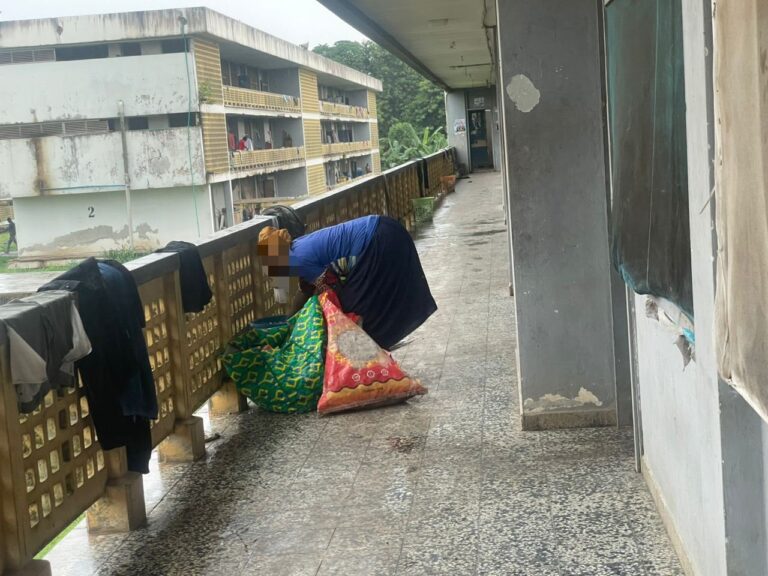
For thousands of students, the hostels of Obafemi Awolowo University are a home away from home, as it’s a place to sleep, refresh, and prepare for the demands of academic life. Yet, every morning before 8 a.m., Mrs Agbaje, a cleaner at Awolowo Hall, has already begun scrubbing the bathrooms of over 120 students. Minutes later, she is found engaging in other cleaning activities like washing the students’ toilets, mopping their corridors, and offloading the refuse accumulated through the day; all for a monthly wage of less than thirty-five thousand naira.

However, Mrs Agbaje is not alone, as this is the reality of the OAU Hostel workers across various hostels at the University.
The reality of hostel cleaner worker
Four of eight undergraduate hostels in Obafemi Awolowo University have blocks that consist of at least three floors. Each floor has about fifteen (15) rooms and at least three bathrooms with two toilets used by dozens of students daily. This means a single block of over one hundred and twenty students contains a minimum of nine bathrooms and like six toilets that require constant cleaning and maintenance.
In an interview with ACJOAU (OAU Campus Press outlet), Mrs Oyeladun, a worker at Fajuyi Hall, opened up about the weight of her daily responsibilities.
She said “In Fajuyi Hall here, two workers are assigned to clean and maintain a single block of three floors, which is okay, but the major challenge I faced is the lack of water, the leakage of water from upstairs and the way the students use the toilets and the bathroom. As some of them will not flush properly, while some will defecate on the floor, and we’ll have to clean them.”
Also, when asked about her salary, she analysed it with the mathematics of survival. She said, “They pay me Thirty Four thousand Naira (N34,000) in a month. And I live around Mayfair; if I’m to come to campus by bus every day, I’ll spend about one thousand naira (N1000) daily and that’s 30,000 naira monthly. If we are to minus it from my salary, I’ll be left with 4,000 naria. So every morning I walk down to work, and when leaving I walk back home.”
Furthermore, according to Mrs Felicia, who cleans a block in Moremi hall of residence and has been working as a cleaner for over 10 years, she noted that only one cleaner is assigned to a block and their duties extend beyond cleaning toilets and bathrooms. They are also responsible for mopping corridors, clearing refuse, washing designated areas and monitoring sanitation standards.
“Most times, I carry water on my head from downstairs to the topmost floor, so that I can clean the toilets and bathroom. I could go back and forth like that more than seven times just to get enough water to do a good job,” she added.
Speaking on the health implications, she noted that she has been sick repeatedly over the past few months, and each time the diagnosis has been majorly as a result of stress.
“Doctors keep telling me that I should reduce my stress, but it is not under my control, and I cannot quit my job, that is all I have to survive, but the pay is small.”
PAY ATTENTION: Follow The Lagos Voice on WhatsApp channel for latest updates
“If they can even increase it to 50 thousand, I will manage it and we can’t protest, nobody wants to lose their job, nobody wants to lead, and we are not under any union, we work for contractors, and they are the ones that pay us.”
Also, Mrs Taiwo, who cleans a block in Alumni, also spoke about the low salary and voiced her suspicions about the contractors, alleging that they might be the ones cutting salaries. “There are many contractors on campus, and all that I know of pays between N31,000 and N34,000 to the workers when we are supposed to be collecting about N70,000.”
She added that; “I understand that the money passes through different stages before it gets to us, and I think that is the problem, people at the top would take their shares too, but they are supposed to consider us, we are the ones facing the dirty toilets and inhaling unhealthy odours. Although they give us tools to work with and the toilets are very difficult to clean because of the number of students using them. Sometimes you have to clean again and again. We have to resume as early as 7 am and finish up in the afternoon; some might not even finish up at 3 pm, when we are all supposed to be leaving because of the hectic work.”
Moreover, Mrs Ajileye, a cleaner from Akintola hall of residence, while relaying her frustration, stated that some students complicate their world by failing to maintain proper hygiene etiquette.
“Some students will pour food inside, sometimes even with water inside their dustbin, waiting for us to come and clean it up. And since it’s a females hostel, some will even leave their pads in the toilet and mess everywhere up with blood stains, and we still have to clean it up though we’ve complained a lot to the porters and even hall wardens, but they only apologise to us on behalf of the students; nothing is being done.”
Lamenting the payment, she said that, “It is too small, sometimes it’s not even enough for transportation. There was a time, I had borrowed so much that by the end of the month, after paying all debt, I was left with N1,200 and If anybody falls sick, even if it is at work, there is no health insurance, no compensation whatsoever, you will have to go and take care of yourself out of that little money.”
Student voice across all hostels
Speaking with students across all hostels on the dilemma of the hostel cleaner workers and their feelings about them.
Akintunde Damilare, a resident of Block 4 in Fajuyi Hall said; “The workers are trying their best but there’s no proper management in the sense that the restroom in a block is very awful. Only a few of the restrooms work and it causes underutilization. Each floor supposedly has more than two functioning restrooms; it shouldn’t be inefficient.
“And because there is not much of it functioning it’s not frugally used. Moreover the workers need equipment for the sanitation for proper cleaning, aside that, if possible they should levitate their wages or salary little compared to the rapid issues of Nigeria economy.”
Also, Israel Osungunna, a resident of Awolowo Hall said; “The workers are trying, but the students won’t let it show because of their misuse. Concerning their payment, I don’t want to believe this because that’s not the minimum wage in Nigeria. I think rules and regulations should be more enforced on students than before,once you misuse you face the penalty and this can be achieved by designating a few student leaders to monitor their usage with basic facilities being provided and each room should have their waste bins.”
Aishat, who stays in Moremi, Block H, said that: “These cleaners really need to improve, I don’t see what they do, the only thing I see them do is to clean the dustbin, they don’t really sweep the floor.”
She added that: “They don’t wash the toilet too many times, they only pour water and hypo or something, it’s always slippery.”
PAY ATTENTION: Follow The Lagos Voice on WhatsApp channel for latest updates
Speaking on the payment of the workers, Aishat said: “ Their salary is too small and I think that is the reason they don’t put all their strength into it. The university should increase their salary.
₦70,000 Minimum Wage: A policy on paper or reality?
The minimum wage has over time been increased to align wages with Nigeria’s rising inflation and cost-of-living pressures, yet cleaners at the Obafemi Awolowo University like Mrs. Oyeladun and many others whose labour keeps the university environment functioning every day have been forced to work and live in a harsh reality of deteriorating economic situation and hard labour without getting up to half of the minimum wage promised by the Nigerian government.
Workers and Workers head reluctant to speak
In a bid to have a get a balance report, ACJOAU reporter visited Mozambique Hall Workers and was directed to speak with the worker head, however, the remark from worker gave impression that they are scared to talk to the press while the worker head was also not ready to talk and ask the reporter not to go to Angola Hall as it’s still the same contractor in charge that they are all fine and they are paying them well and the students are cooperating.
Editor’s Note: The names of all hostel workers and students featured in this report have been changed to protect their identities. Their real identities have been verified by the reporting team. This investigation was first published by the Association of Campus Journalists (ACJ), Obafemi Awolowo University. The Lagos Voice is republishing the report to broaden public awareness and extend the reach of its findings.