


By Taiwo Ramat
Universities in Nigeria rarely leave room for anything outside the syllabus. Between lectures, assignments, and the pressure to graduate with a good CGPA, most students consider it a formality, just to keep up. Yet, a fair number of young people manage to build something else entirely on the side: a business, a skill, a talent, often without lecturers or classmates ever finding out until it’s too big to ignore. Some students have turned that side pursuit into an actual source of income. Others turn it into a name and a career for themselves in a field that has nothing to do with what they’re being taught at the University. Confidence Akinyemi belongs to that second group.

At Obafemi Awolowo University, Confidence Akinyemi is known for two very different things. In the Department of Accounting, he’s the 400-level student who interned in the Investment Banking Division at Asset & Resource Management Holdings in Lagos, after being selected among the top one per cent of Nigerian undergraduates for the program. In OAU, he currently serves as Head of Career Development for the Student Finance Club.
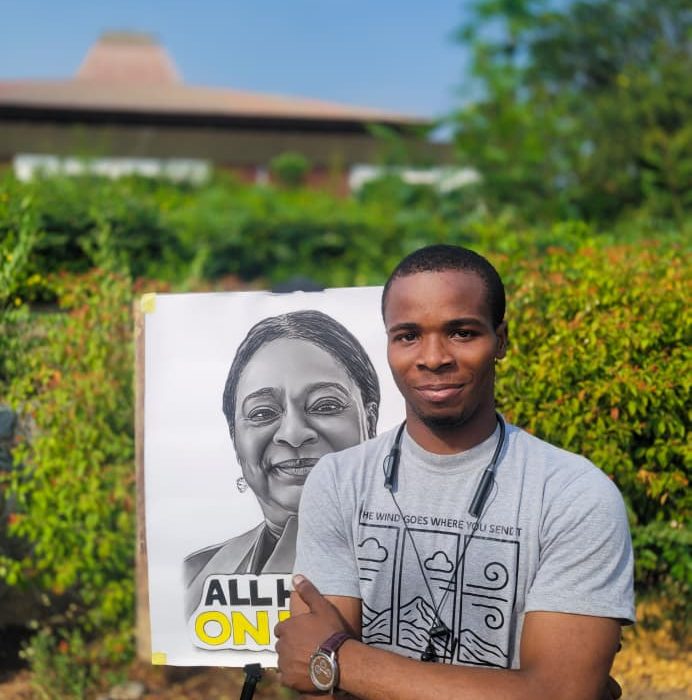
But walk into a different room on the same campus, and people know him for something else entirely: perfect pencil portraits, good enough to have reached the desks of a sitting president, a revenue service chairman, and two university vice chancellors.
Akinyemi has been drawing since he was a child, copying faces out of comic books and dictionaries long before he thought of it as a skill or a source of income. “Everyone knew that ‘Confidence’ could draw,” he said. It was not until 2018, when he was introduced to portrait drawing specifically, that something changed. From there, he improved, in his words, “piece after piece.”
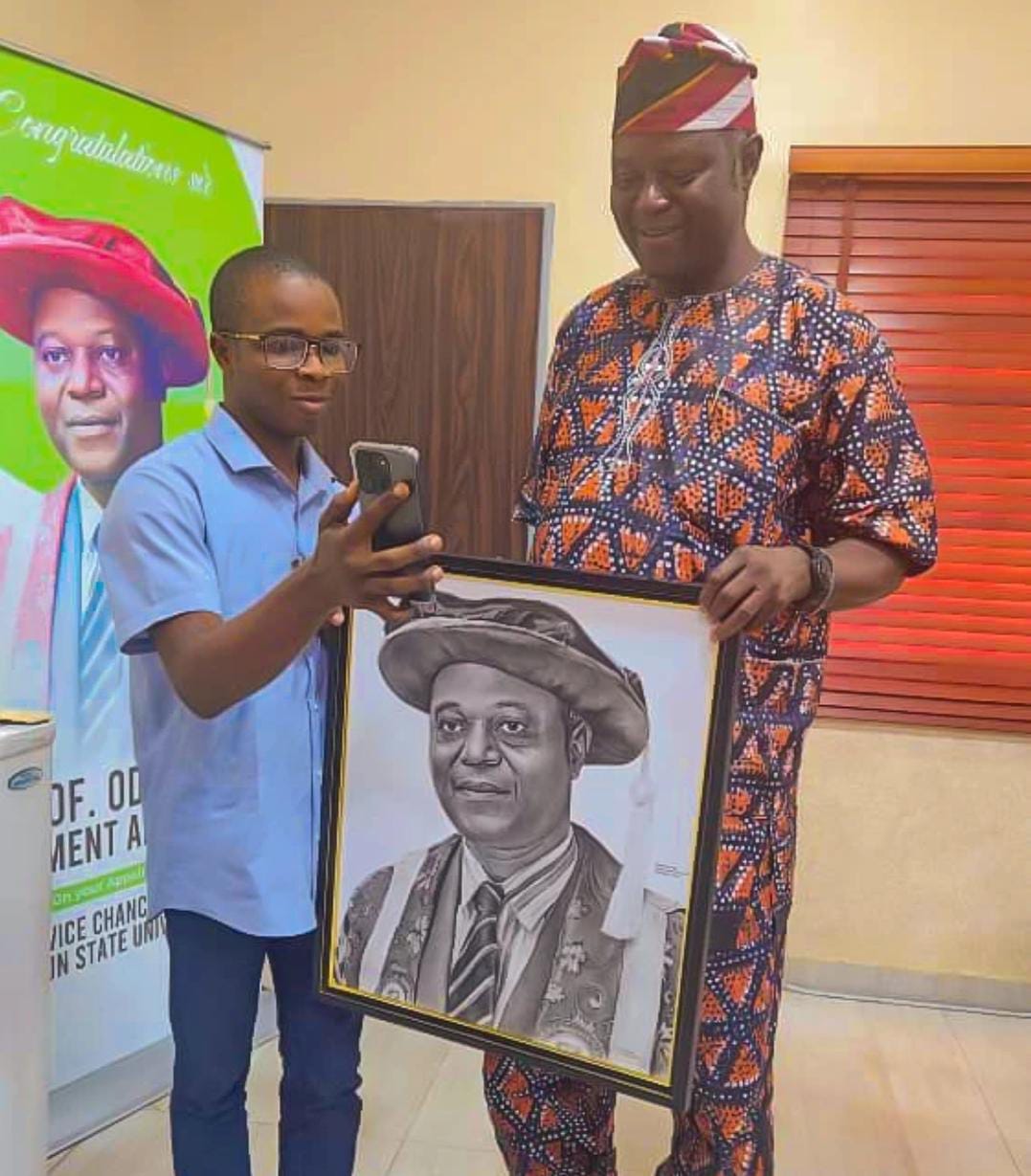
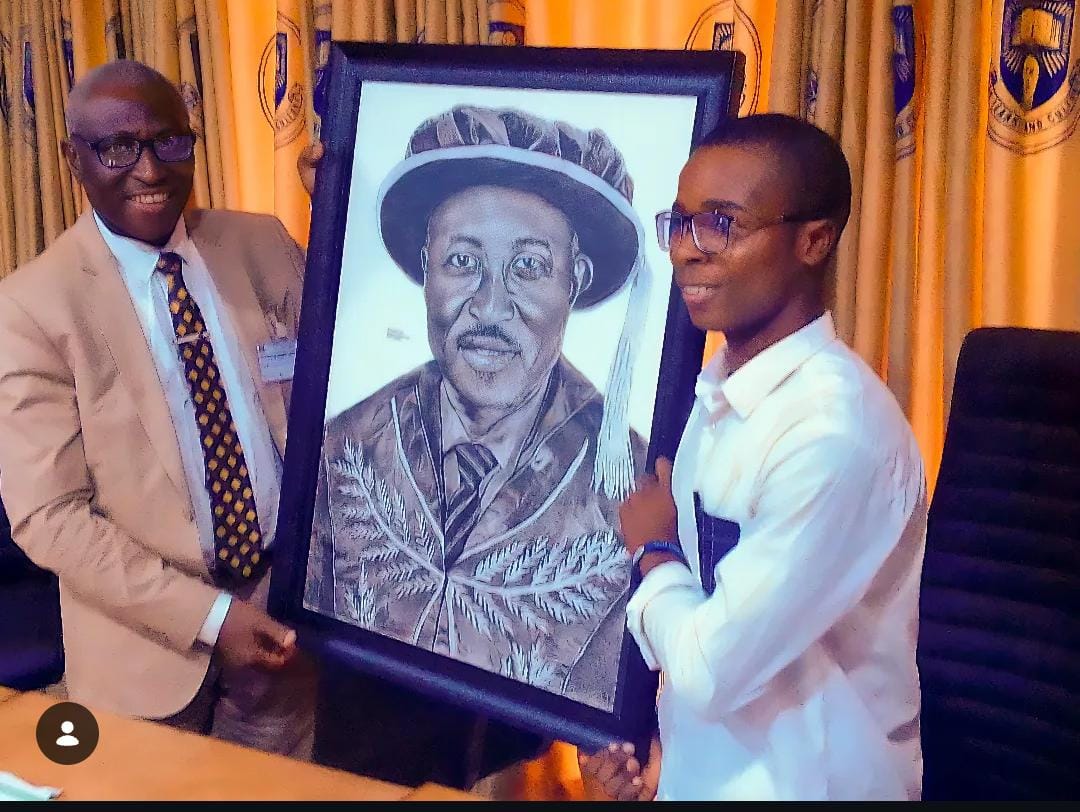
By the time he reached university, that childhood habit had turned into something closer to a second career. In his first year, he drew Professor Simeon Bamire, OAU’s Vice Chancellor, and the piece got him noticed across campus. The commissions kept getting bigger from there: the Vice Chancellor of UNIOSUN, the Dean of Student Affairs, and Zacch Adedeji, Chairman of the Nigeria Revenue Service. In 2023, he drew President Tinubu and titled it “Emi Lokan,” borrowing the phrase that had defined Tinubu’s campaign. It spread fast.
None of this happened because Akinyemi set out to become an artist. If anything, he nearly avoided it. “There has always been a notion that Art is for ‘unserious’ people, and I didn’t want to have that label,” he said in an interview with The Lagos Voice, explaining why he leaned toward Commercial subjects over Fine Art, and eventually accounting over anything creative on paper. He did not dislike the sciences; he just felt no pull toward them. Accounting, by comparison, appealed to him on its own terms.
What he did not plan for was how much the two sides would end up leaning on each other. “Accounting is based on principles and standards, so all I have to do is understand the structure, work with it, and apply it in the necessary areas,” he mentioned to The Lagos Voice. “But my art gives me a creative advantage.” In his opinion, it isn’t a fight between logic and imagination but much more of a working partnership; one side handles the rules, the other supplies the ideas that don’t come from a textbook, he added.
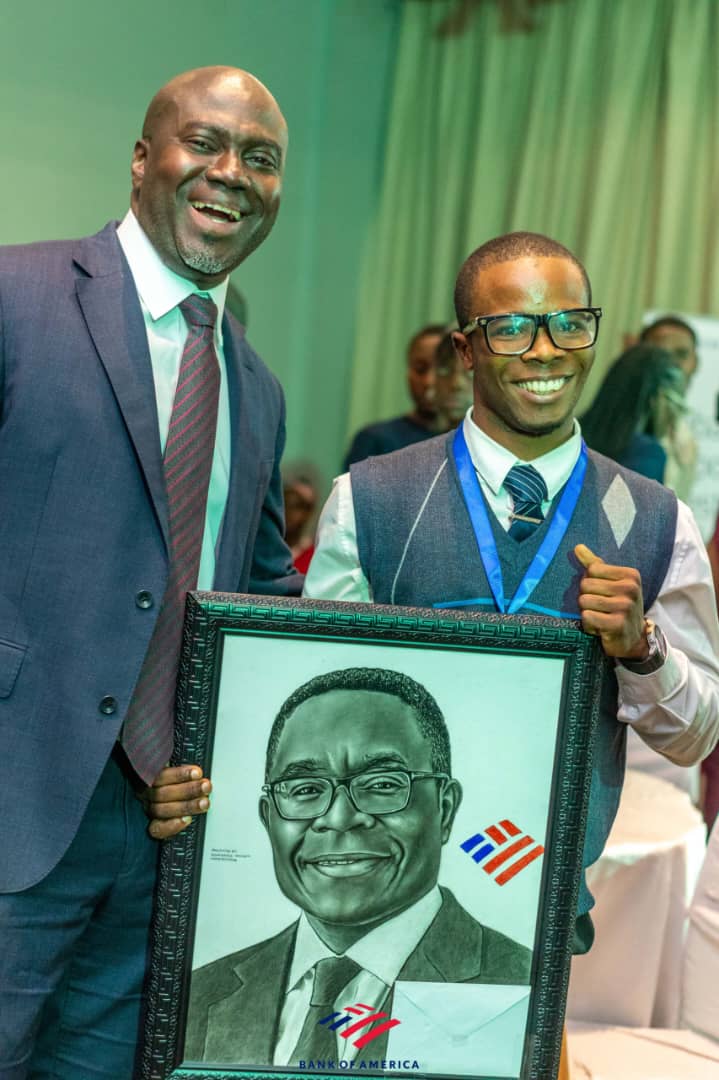
Living both lives at once has come at a cost, mostly measured in sleep. Akinyemi has drawn the night before exams more than once, racing to meet a client’s deadline with a test waiting the next morning. During his ATS 3 exam preparation, with a week before the exam, he still made time to draw the President of Bank of America International. “My books and academics take No. 1 priority,” he said, “but I have still always made time intentionally for my art.” He credits careful planning and what he simply calls God helping him for keeping both sides from collapsing.
It has not always felt sustainable. Between his first and second year, during an exam for a course called SSC 202, he sat in the hall, and he was blank, not knowing what to write. He did not know the answers. Right there, he decided he was done with drawing for good; the time would go into his books instead. The decision did not hold. “My pencils always find their way back into my hands,” he said. Usually through a commission from someone he could not turn down. Every plan to quit falls apart the same way eventually, he told The Lagos Voice.
His most personally significant piece isn’t one of the political portraits. It is a project called BLOOM, which he calls his biggest highlight so far. The reason has less to do with attention and more to do with what the piece was trying to say. Built around a message about God’s timing, with Blessing Abeng, founder of Ingressive for Good, as his muse, the piece drew a different kind of response than his other work. People told him it had blessed their lives, he said, and that mattered to him.
None of his artworks has turned into major art sales yet. “Not yet, anyway”, Confidence said. But it has opened doors he probably would not have found on his own, the kind of rooms most 300-level or 400-level students never get close to. He has sat across from Vice Chancellors. Authors know his name. Serious art collectors have reached out to him directly. This occurred without an agent or a gallery, simply because a portrait found its way to them. None of that happened because of his CGPA. It happened because somebody saw a drawing, asked who made it, and went looking for him. He is not interested in picking one identity over the other going forward.
When asked how he sees himself five years from now, whether as an accountant who paints or an artist who studied accounting, he didn’t hesitate: A finance professional who paints!! He mentioned. I genuinely love the corporate world too!. He is confident about grooming the niche field called Art & Finance. Artwork in this field is treated as an asset class and traded like bonds or stocks. He says he wants to explore that space eventually.
For now, his focus is on a platform called Spotlight Africa. It is built to connect upcoming African artists to collectors and art lovers worldwide. The idea came directly from his own frustration as a student artist who struggled to sell his work. He’s currently seeking seed funding, and says any support would go straight into building the platform out.
A message boosting his story motivates him. Akinyemi keeps it simple: do not wait for free time to show up on its own. “If you wait to find time, you’d most likely find none,” he said. “Create time.” It sounds obvious when he says it. It’s also exactly what he’s been doing, one exam and one commission at a time, for six years.




Bukola
August 28, 2026Wow, Confidence is an epitome of excellence! Rare excellence even.
Studying accounting at one of the most rigorous tertiary institutions in Nigeria is already strenuous on It’s own. Yet he’s still able to spend hours carefully fine-tuning his art pieces, it’s really lovely.
Africa definitely needs more excellent individuals like Confidence
Confidence Akinyemi
August 28, 2026Thank you so much, The Lagos Voice!!!
Afeez Ogunfowokan
August 28, 2026Hello sir, Mr Akinyenmi,
My name is Afeez from Olabisi Onabanjo University. I really love your works sir and please sir I’m also interested in learning sir.
May the lord continue to supply you more wisdom in Jesus name
Akinyemi Ijeoma Beatrice
August 28, 2026Akinyemi Confidence’s hands is blessed and I believe the word of God that says ” a man’s gift makes room for him
Temitope Ademokoya
August 28, 2026Thank you for sharing your story Confidence, it is very inspiring.
I learnt that two realities can coexist, I don’t have to kill one dream to bring the other to life.