


By Fatimah Idera
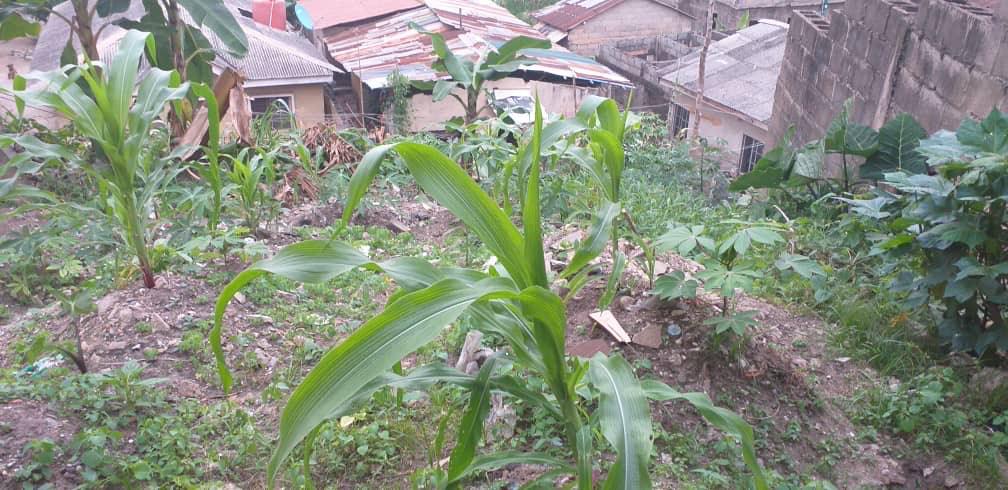
Despite growing up in an urban area and getting married in Lagos, South-West Nigeria, Ariyo Blessing, a 40-year-old teacher, has nurtured a lifelong passion for agriculture since her childhood.


She told The Lagos Voice that her passion began at a young age, when she was taught in school that crops harvested from one’s farm are not only safe but also more nutritious.
“Since then, I told myself that I would one day get a space or land to farm so my family would eat fresh fruits, vegetables, and livestock,” she said. She stated further, “Buying vegetables in Lagos markets can be very deadly, as many are treated with chemical processes, and I never wanted to risk my family’s health. So I began backyard farming this year in my family’s house.”
Amid efforts to sustain these efforts, the livestock she raises often feed on her plants, leading to poor yields. As a mother of three, she also struggles to plan her planting cycles properly and to access seeds. “These baffle me, and sometimes I fear I might lose my passion for farming,” she told The Lagos Voice.
Farming in the urban
Farming is largely associated with rural areas, as the unavailability of space and the hazardous impacts of emissions from industries dominate cities.
In Nigeria, urban farmers face numerous challenges, particularly in densely populated areas filled with skyscrapers, such as Lagos, where access to seedlings can even be difficult.
Women who own their homes often find it easier to farm compared to tenants, who face issues like neighbours’ pets or children damaging plants. Others are unable to farm at all due to environmental or climate factors.
According to Statista, an online platform that specialises in data gathering and visualisation, Nigeria’s Lawn & Garden market is projected to reach US$3.33 billion in revenue in 2025, with an expected annual growth rate of 7.08 per cent (CAGR 2025-2029).
Globally, several countries actively support urban backyard farming. In Japan, rooftop gardens and indoor facilities like the Pasona Urban Farm are widespread. In Ghana, market gardens on marginal land near water bodies supply a large share of vegetables while improving the environment. In Botswana, South Africa, and Zimbabwe, urban residents are turning to backyard farming to combat food insecurity and economic pressures.
It also helps to tackle climate-related challenges such as greenhouse gas emissions and the urban heat island effect.
Inspiring stories in Lagos
Like Mrs Ariyo, Victoria Olugbenga, a resident of Alimosho, joined backyard farming through an agricultural initiative that now earns her a daily income.
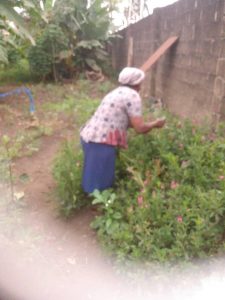
While it has not been easy for her to combine secular work with farming, “God’s grace has kept us going,” Mrs Olugbenga told our reporter.
Although she started small, her harvests now feed her household and allow her to make purchases she never thought possible. Mrs Olugbenga attributed her success to the Beellahy Foundation, a non-governmental organisation founded in 2019 by Adenike Erinoso, to change the narrative for women and children.
In 2024, it launched the Beellahy Foundation Women for Agricultural Initiative (BFWAI), which trained over 100 women on backyard farming. Both Mrs Ariyo and Mrs Olugbenga were part of the training, and they have since then developed more interest in small-scale farming.
For Mrs Olugbenga, the training was transformative. “Now, I pluck fresh vegetables for my family, and even my community benefits. My neighbour came to ask for vegetables, and I am happy to share.”
Also, Mrs Ariyo credits the foundation for reviving her dream. “My neighbour introduced me to the Bellahy Foundation. They taught us how to plant, avoid waste and choose the right time to farm. They also gave us crops to start with. That saved my passion.”
PAY ATTENTION: Follow The Lagos Voice on WhatsApp channel for latest updates
The women added that they now sell some of their produce to friends and families through their WhatsApp groups and other social media channels.
Speaking on the training programme, Beellahy Foundation Founder, Mrs Erinoso, said the idea was to ensure a backyard farm produces ingredients like pepper, okro, ginger and vegetables for home-cooked meals.
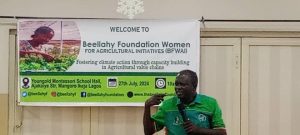
“We trained them using old containers, buckets and tyres to start small. From there, they can later grow into greenhouse farming. The aim is food security and climate action,” she told The Lagos Voice. “The women were taught how to cultivate crops and rear livestock, including snails. The foundation also provides seeds and fertilisers to strengthen their agricultural skills.”
“Many women have improved their nutrition by saving money on transport and market food, which often has low nutritional value. Now, they have direct access to fresh produce,” Mrs Erinoso added.
More testimonies
In the Ketu area of Lagos, Ruth Adeboye integrates backyard farming into her daily routine, as she cultivates cassava, maize, tomatoes and peppers. She said it saves her money she would have spent in the market.
Similarly, Akinrinade Alabi, a nurse/anaesthetist living in the Ifako-Ijaiye area of Lagos, sees farming as a way to appreciate nature.
“Backyards have shown me the richness of our soil. Every morning and evening, I check my plants. It makes me happy to contribute to Nigeria’s food security,” she said. “My backyard farming saves me some money and time. In fact, the proximity and freshness of the product can’t be overemphasised.”
Speaking on the challenges faced by women trying to cultivate their meals, Mrs Alabi said that while weeding, especially during the rainy season, is a problem, irrigation during the dry season is also difficult.
Enyi Paul, an agriculturalist and CEO of Growth Mind Farms, added that “urban farming, particularly for women who may be interested in commercial agriculture, is difficult due to space and resources. 80 per cent of the food crops produced in the rural areas find their way to the Urban centres where they are more valuable in terms of profit.”
He explained that one of the reasons why food crops are expensive in urban areas is the high cost of transportation.
To maximise space, Mrs Alabi urged women to adopt modern farming techniques such as planting in sacks, pots, or plastics.
“Backyard farming doesn’t require too much money. With just ₦1,000, you can buy different vegetable seeds. Plantain and banana suckers can even be gotten free from farmers.
My actions encouraged others, as I have male volunteers who sometimes help me. Now, I proudly call myself a farmer,” she explained.
Meanwhile, Beellahy Foundation plans to digitise its training so women can monitor their soil, manage their farms, and keep records online.