


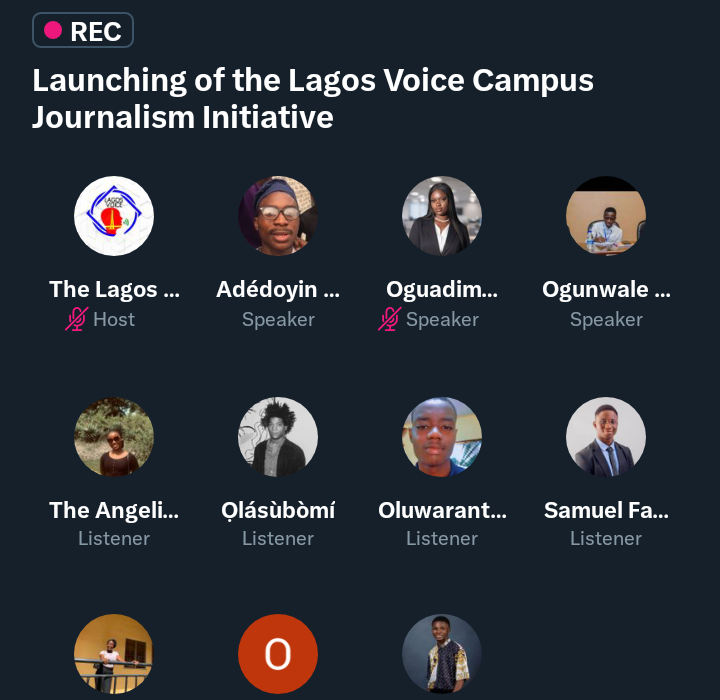
The Lagos Voice has officially launched its Campus Journalism Initiative, a platform designed to amplify student voices and nurture the next generation of ethical and impactful journalists. The initiative was unveiled on Sunday, 25th January 2026, during an interactive X (formerly Twitter) Spaces session themed ‘Empowering Young Journalists with a Voice.’
The launch attracted student journalists, media practitioners, and youth advocates from across the country, growing interest in campus-based storytelling and youth participation in national conversations. The session was moderated by Jacinta Chisom, who guided discussions around the role of young journalists in shaping narratives and holding institutions accountable.

Delivering the welcome address, Adedoyin Oguntade, managing editor of The Lagos Voice, thanked participants for joining the space and outlined the vision behind the Campus Journalism Initiative. According to him, the project is rooted in the newsroom’s broader commitment to youth empowerment.
‘The Lagos Voice Campus Initiative works directly with the newsroom because journalism and youth empowerment are deeply connected,’ Oguntade said. ‘We are providing a platform for student journalists to tell their stories, sharpen their skills, and contribute meaningfully to public discourse.’
The keynote address was delivered by David Olatunji, editor-in-chief of The Lagos Voice, who spoke passionately about the power and responsibility of young journalists in today’s media landscape. He described young journalists not merely as reporters but as storytellers, change-makers, and amplifiers of voices that often go unheard.
‘Youth is not a limitation; it is a strength,’ Olatunji noted. ‘It gives you a fresh lens, a unique perspective, and the passion to tell stories that truly matter.’ He highlighted how young Nigerian journalists are already leading conversations on climate change, social justice, and governance through innovative tools including social media, podcasts, and multimedia storytelling.
Olatunji emphasised that empowering young journalists goes beyond access; it requires tools, mentorship, safe spaces for learning, and platforms that celebrate excellence. He also reminded participants of the ethical responsibility that comes with journalism, urging them to shape narratives responsibly, challenge stereotypes, and promote inclusivity.
‘Use your power wisely,’ he advised. ‘Tell stories that uplift, educate, and inspire. When the journey gets tough, remember why you started, to make a difference.’
Also speaking at the event was Matthew Ogunwale, campus editor of the Lagos Voice Campus Initiative, who provided detailed insights into how the initiative will operate across campuses. Matthew explained that the programme is structured to bridge the gap between campus realities and national discourse while grooming student contributors for professional journalism.
He announced that students interested in contributing can submit their reports via lagosvoicecampusinitiative@gmail.com, using the story title as the email subject. Submissions must be sent as Word documents, accompanied by a short biography of the reporter. He added that stories should be between 300 and 1,500 words, depending on the format and the depth of the narrative.
Beyond submissions, Matthew outlined the broader framework of the initiative, which includes editorial oversight, mentorship, and periodic evaluations by the Lagos Voice Campus editorial team. High-quality campus stories will be integrated into The Lagos Voice’s main platform, creating a clear pipeline for student journalists into professional media practice.
PAY ATTENTION: Follow The Lagos Voice on WhatsApp channel for latest updates
The initiative’s vision is to build a vibrant campus-based media ecosystem where young people use responsible journalism and strategic storytelling to influence policy, amplify underrepresented voices, and contribute meaningfully to society. Its core objectives include equipping students with practical media skills, promoting ethical and solution-driven reporting, encouraging youth civic engagement, and strengthening the link between campuses and national conversations.
Training, described as the backbone of the initiative, will be held quarterly and delivered through physical workshops and virtual platforms such as X Spaces, Zoom, and Google Meet. Training areas will cover news writing, interviewing skills, fact-checking, media law, feature writing, investigative journalism (basic level), and group editorial review sessions.
Campus contributors will focus on stories around campus governance, education policy, youth participation in democracy, social issues, innovation, and human-interest reporting. A structured submission and review process will ensure accuracy, editorial quality, and ethical standards.




Jacinta Chisom
January 27, 2026This is a great move.