


By Shittu Daniella Ayomiposi
As the 2026 FIFA World Cup 2026 progresses into its knockout stages, the world’s attention has been captivated by breathtaking goals, unexpected upsets, and the rise of underdog nations.

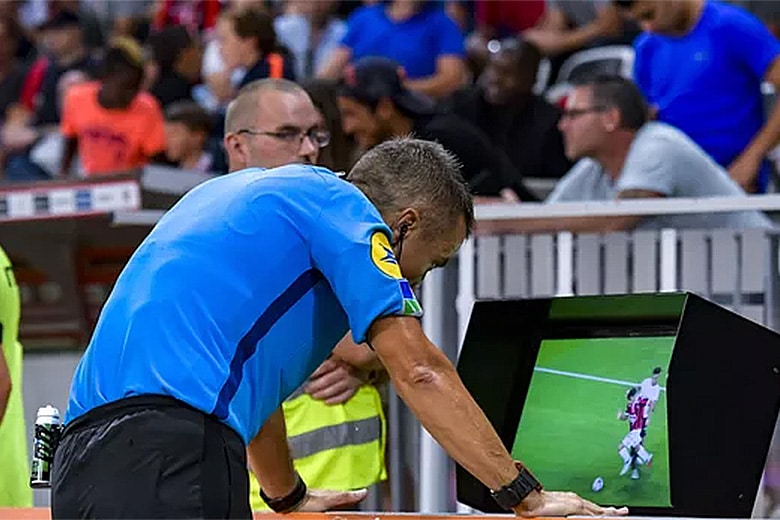
Yet, beyond the excitement on the pitch, another subject continues to dominate conversations among players, coaches, referees, pundits, and supporters alike: the Video Assistant Referee (VAR).
Since its introduction at the 2018 FIFA World Cup, VAR has transformed football officiating by providing referees with technological support to review crucial decisions. Designed to reduce clear errors, the system has become one of the most significant innovations in modern football. However, despite its objective of promoting fairness, VAR remains one of the sport’s most polarising topics.
PAY ATTENTION: Follow The Lagos Voice on Facebook and WhatsApp channel for latest updates
The 2026 FIFA World Cup has once again placed the technology under intense scrutiny, raising an important question: Is VAR making football better, or is it taking away some of the game’s magic?
Technology in the Service of Fairness
Football has always been celebrated for its unpredictability, but it has also suffered from controversial refereeing decisions. History is filled with disputed goals, missed penalties, and incorrect red cards that have altered the outcome of important matches.
To minimise such errors, FIFA introduced VAR to assist match officials in reviewing four key situations: goals, penalty decisions, direct red cards, and cases of mistaken identity.
PAY ATTENTION: Follow The Lagos Voice on Facebook and WhatsApp channel for latest updates
At the 2026 World Cup, the system has been further enhanced with advanced technologies such as semi-automated offside detection, AI-assisted analysis, and connected match balls capable of providing precise positional data. These innovations are intended to speed up reviews while maintaining greater accuracy.
Supporters of VAR argue that these technological improvements have made officiating more reliable than ever before. By giving referees access to multiple camera angles and real-time data, the likelihood of decisive mistakes affecting the outcome of matches has been significantly reduced.
VAR’s Impact at the 2026 World Cup
Throughout the tournament, VAR has been involved in several key moments that have influenced matches and sparked widespread debate.
In one group-stage encounter, a Colombian goal against Portugal was ruled out after a marginal offside review, with the decision prompting fresh discussions about whether technology has made offside calls too precise.
PAY ATTENTION: Follow The Lagos Voice on Facebook and WhatsApp channel for latest updates
Another controversial incident occurred when a dramatic goal by DR Congo was disallowed following a VAR review, a decision that drew strong criticism from football analysts and supporters who questioned whether the intervention reflected the spirit of the game.
Meanwhile, Ghana’s head coach publicly criticised VAR after his side’s goalless draw with England, arguing that the technology failed to intervene in incidents he believed warranted a penalty and a red card. His comments reflected a growing concern that while VAR exists to eliminate obvious mistakes, inconsistency in its application continues to frustrate teams.
These incidents demonstrate that while technology can provide additional information, it cannot eliminate differences in interpretation.
The Case for VAR
Many football experts maintain that VAR has made the game fairer.
Referees operate under enormous pressure, often making split-second decisions in front of millions of viewers. Even the most experienced officials are capable of making mistakes.
PAY ATTENTION: Follow The Lagos Voice on Facebook and WhatsApp channel for latest updates
VAR offers referees a second opportunity to review incidents that may determine the outcome of a match. Goals scored from offside positions can be disallowed, legitimate penalties can be awarded after being initially missed, and dangerous tackles can receive appropriate punishment.
Former referees have also praised FIFA’s approach during the 2026 World Cup, noting that reviews have generally been completed more quickly than in some domestic leagues. Rather than interrupting play unnecessarily, officials have focused on correcting only clear and obvious mistakes while allowing the flow of matches to continue whenever possible.
For many supporters, fairness should always outweigh convenience. If technology can prevent a nation from being unfairly eliminated because of human error, they argue it is a necessary part of modern football.
The Growing Criticism
Despite these advantages, criticism of VAR has not disappeared.
One of the most common complaints concerns the interruption of football’s emotional rhythm. Supporters are increasingly hesitant to celebrate goals immediately, knowing that every important attacking move could be subjected to review.
PAY ATTENTION: Follow The Lagos Voice on Facebook and WhatsApp channel for latest updates
Lengthy pauses while referees examine video footage can reduce the excitement inside stadiums and in front of television audiences. Critics believe these interruptions affect the natural flow that has always made football unique.
Another concern is consistency
While VAR has corrected numerous mistakes, similar incidents sometimes receive different outcomes in different matches. Decisions involving handballs, physical challenges, and penalties often remain open to interpretation, leaving supporters questioning why identical situations are judged differently.
As a result, many argue that VAR has not removed controversy from football, it has simply changed the nature of the debate.
PAY ATTENTION: Follow The Lagos Voice on Facebook and WhatsApp channel for latest updates
Football Still Depends on Human Judgment
Perhaps the greatest misconception surrounding VAR is that technology alone determines decisions.
In reality, the final authority always remains with the referee. VAR provides information and recommendations, but it does not replace human judgment.
This means that although technology can improve accuracy, controversial decisions are likely to remain part of football because interpretation will always differ between officials.
As one football analyst observed, “The final call is still human.” Even with sophisticated technology, referees must interpret what they see according to the Laws of the Game.
Finding the Right Balance
Rather than asking whether VAR should remain in football, many experts now believe the more important discussion is how the system can continue to improve.
PAY ATTENTION: Follow The Lagos Voice on Facebook and WhatsApp channel for latest updates
Suggestions include reducing review times, improving communication between referees and supporters inside stadiums, increasing transparency regarding decision-making, and ensuring greater consistency in applying the Laws of the Game.
FIFA’s continued investment in advanced officiating technology demonstrates its commitment to balancing fairness with the speed and excitement that supporters expect from football.
The 2026 FIFA World Cup has once again shown that VAR is both a solution and a source of debate.
There is little doubt that the technology has corrected important refereeing errors and helped produce fairer outcomes in several matches. At the same time, controversial decisions, interrupted celebrations, and differing interpretations continue to fuel passionate discussions among football fans worldwide.
PAY ATTENTION: Follow The Lagos Voice on Facebook and WhatsApp channel for latest updates
As football evolves, VAR is unlikely to disappear. Instead, its future lies in becoming faster, clearer, and more consistent. While technology can support referees in making better decisions, it cannot replace the human element that has always been at the heart of the world’s most popular sport.
Ultimately, the debate surrounding VAR reflects football itself—passionate, emotional, and constantly evolving. Whether supporters view it as the game’s greatest innovation or its most controversial addition, one fact remains undeniable: at the 2026 FIFA World Cup, VAR has become almost as talked about as the football itself.