

By AbdulHakeem Salami
Journalists who covered the recently concluded Osun State governorship election have said that despite heavy youth engagement on social media, that activism has not fully translated into voter turnout, sustained accountability, or political power, raising questions ahead of Nigeria’s 2027 general elections.

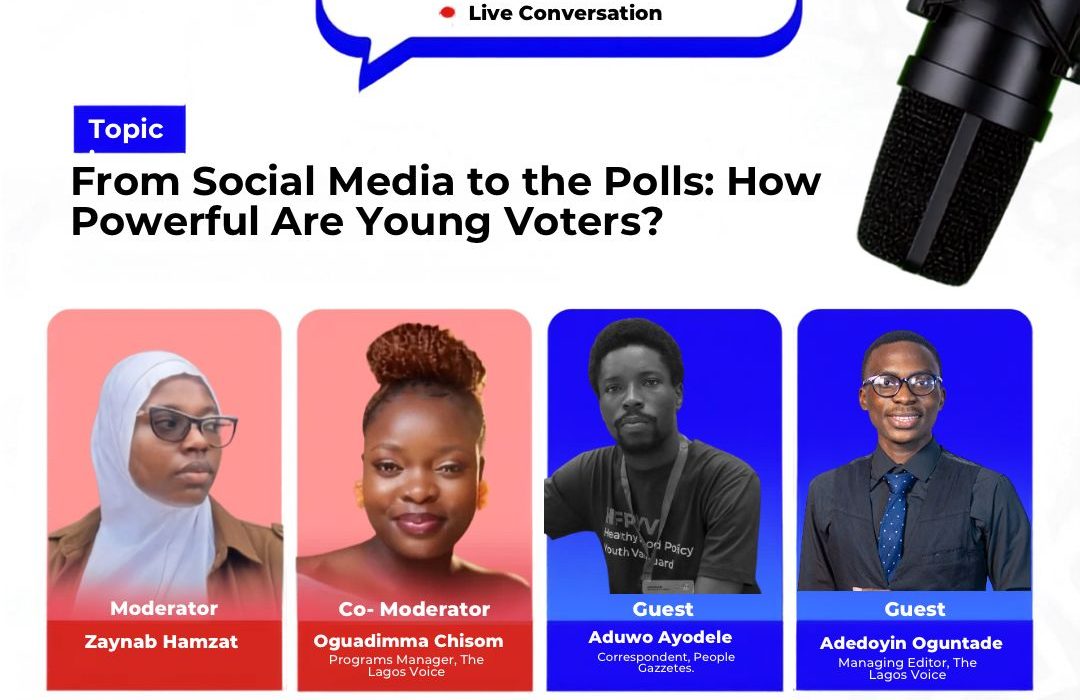
This was the submission of Aduwo Ayodele, a correspondent with the People’s Gazette, and Adedoyin Oguntade, Managing Editor of The Lagos Voice, during an X Space hosted by The Lagos Voice on Sunday. Titled “From Social Media to the Polls: How Powerful Are Young Voters?”.
Opening the conversation, the host, Zaynab Hamzat noted that during the Osun election, social media became an important space for political mobilisation, with many people closely monitoring INEC’s page for results as they came in. She said that with political actors already putting forward their promises and visions ahead of 2027, the key question is whether young Nigerians will simply listen, or challenge candidates and demand accountability.
Oguntade said there was no straightforward yes-or-no answer to whether online engagement translates into votes, noting that social media plays a real social function beyond entertainment, allowing political interests and ideas to be framed and spread. He said young people were highly active in the lead-up to the Osun election, debating and defending their preferred candidates online, but that this activity “doesn’t automatically translate into election results.”
He said he did observe some young people who were active both online and physically at the polls, including some who stayed to monitor vote counting, and that after results were declared, some returned to social media to reference the outcome in arguments with rival supporters. He said the priority going forward should be converting active online presence into active physical presence at the polls.
On why a gap exists between youth political energy online and actual voter turnout, Oguntade cited a survey conducted earlier this year by the Center for Journalism, Innovation and Development on youth perception of elections and governance in Osun and Ekiti States, in which he personally took part as a surveyor.
He said the survey found that many young people have lost hope in the democratic process, believing it is unfair and that their choices are not properly reflected in outcomes, while others remain simply ignorant of the process, some not even possessing a voter’s card. He said the remedy is proper civic sensitisation to help young people understand the power they hold as citizens.
PAY ATTENTION: Follow The Lagos Voice on WhatsApp channel for latest updates
Speaking on the media’s role, Oguntade said the media remains a key stakeholder in any democratic process and is already putting in strong effort, but argued that conversations around accountability should not be treated as passing commentary. He referenced the media’s agenda-setting role in shaping public decisions and called for a greater intensity of sensitisation and public information than currently exists.
Asked whether young Nigerians, who make up an estimated 70 percent of the population, currently hold enough political power to influence election outcomes, Oguntade pointed to the 2023 general election, where strong youth mobilisation behind Peter Obi did not ultimately change the result. He said what currently exists should be described as “potential” rather than power, adding that this potential could grow if the right pressure is applied in the right places. In his closing remarks, he urged young Nigerians unsure whether their votes count to embrace optimism, saying the outcome of the process cannot be known unless it is attempted.
Turning to Ayodele, the is questioned on how young people can turn their voice into real accountability beyond tweeting and posting, particularly where politicians make campaign promises and later fail to deliver. Ayodele said youth participation in the Osun election, while present, was not at its best. Citing his coverage of Ejigbo and Osogbo, the state capital, he referenced an incident in Ejigbo in which the polling unit of ADC candidate Najim Salam was disrupted by a group of thugs identified as “Big Hammer,” made up of youths.
He said young people represent a pillar of strength in the political system, but that posting online is not enough on its own and must be paired with more deliberate action, including continued use of social media to hold leaders accountable, without allowing themselves to be used as tools for election violence. He called for an increased non-violence campaign among youths and said accountability must extend beyond election day into how leaders actually govern.
PAY ATTENTION: Follow The Lagos Voice on WhatsApp channel for latest updates
Asked how young people can hold politicians accountable for promises that are often not clearly visible, especially at the state and local level, Ayodele said political figures do communicate their plans, and that with the reach of the digital economy, not knowing a candidate’s promises is no longer an excuse, the issue, he said, is that many people are simply not paying attention.
A participant, identified as Weng, cited the #EndSARS protests as an example of online mobilisation translating into real-world impact once youths took to the streets, and asked, given that youths make up roughly 60 percent of the population, what could be done to increase election turnout and physical mobilisation. The panel pointed back to the need for sustained optimism and continuous encouragement of participation among youths.
Asked why some young people agree to engage in electoral violence when financially induced, and how they might be made to weigh short-term financial benefit against long-term consequences, Ayodele attributed the trend largely to poverty and ignorance.
He proposed a three-part response: consistent efforts by the media and other agents of socialisation to discourage violence at every level, strict neutrality by security agencies during elections, and firm judicial action against anyone found sponsoring or aiding electoral violence.
PAY ATTENTION: Follow The Lagos Voice on WhatsApp channel for latest updates
On concerns about young people being intimidated over political opinions posted online, Ayodele advised that content should be verified as accurate before posting, noting that freedom of expression does not extend to statements made inaccurately. Asked whether young Nigerians are more drawn to individual candidates or to political parties, he said people are generally drawn to both.
Ayodele gave a final remark that continuous engagement with elected leaders, and treating accountability as an ongoing responsibility rather than an election season activity, will be central to how much influence young Nigerians ultimately wield in the 2027 general elections.