


By Esther Adegunle
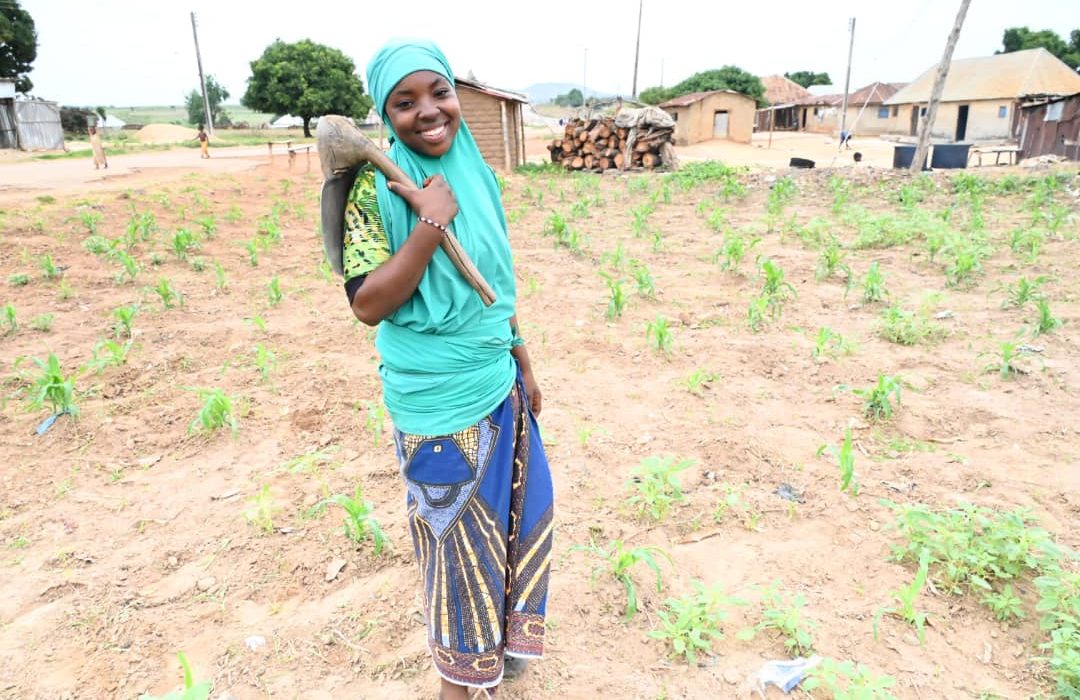
At 19, Fatima Yakubu is a farmer, student, entrepreneur and Integrated Pest Management Community Champion in Kwakuti, Niger State. She farms, but she also shares knowledge with fellow farmers on identifying pests early and using more environmentally friendly ways to manage them.

“Farming has given me a lot; knowledge, income, and confidence. I want to keep learning, and I want to teach others too. Especially girls. We can do so much if we’re given the chance.” — Fatima Yakubu
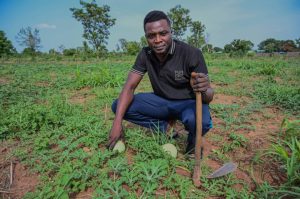
In Nasarawa State, 21-year-old Inarigu Emmanuel balances farming with another passion: football. By accessing high-quality seeds, fertilizer, training, and field support from One Acre Fund (OAF), he boosted his maize yield from a single bag to seven. The extra income helps support his family while funding his goal of becoming a professional goalkeeper.
Neither story begins with a young person reluctantly turning to agriculture because there are no other options.
They are stories of young people choosing to engage with agriculture, and finding ways to make it work alongside the lives they want to build.
That matters because one of the most persistent assumptions about agriculture is that young people are simply not interested in it.
The evidence tells a more complicated story.
Young Nigerians are participating in agriculture and the wider agrifood economy in ways that extend beyond traditional farming. The question is not whether young people are interested. It is whether Nigeria’s food system can create enough viable opportunities for them to enter, grow and stay.
That question is becoming more urgent as Nigeria confronts a serious food-security challenge.
In June 2026, the Food and Agriculture Organization and the World Food Programme placed Nigeria among the world’s highest-concern hunger hotspots. Their latest assessment projected that 34.8 million Nigerians could face high levels of acute food insecurity between June and August 2026, including 1.8 million people at emergency levels.
Young people will not solve this challenge alone. But a country facing simultaneous food and employment pressures cannot afford to overlook a generation already participating in its food economy.
The myth of an uninterested generation
A 2025 analysis by the International Food Policy Research Institute offers a more nuanced picture of young people’s relationship with Nigeria’s food system. Between 2003 and 2022, agriculture’s share of total employment fell from 58% to 35%, while employment in non-farm agrifood activities rose from 12% to 33%. Over the same period, youth participation in non-farm agrifood employment quadrupled.
The story, then, is not simply that young people are leaving agriculture.
Nigeria’s food system is changing, and young people are moving through it.
Some are farming. Others are processing, trading, transporting, building businesses or providing services around food. The boundaries between agriculture and other forms of enterprise are increasingly blurred.
PAY ATTENTION: Follow The Lagos Voice on WhatsApp channel for latest updates
Fatima and Emmanuel represent one part of that picture: young people making agriculture work alongside other ambitions.
The challenge is to make these pathways productive and sustainable enough for more young people to enter, and for those already participating to build viable livelihoods.
Choosing agriculture does not make the path easy
Opportunity, however, does not mean access.
According to the Central Bank of Nigeria, agriculture contributes more than a fifth of GDP and remains a critical source of livelihood across the country. Yet less than 5% of banks’ credit goes to the sector, and the CBN identifies limited access to finance from traditional banks as a major challenge to agricultural development.
For a young farmer, that gap has practical consequences.
Capital is often needed before planting, when income from the crop is still months away. A loan that arrives too late may miss the production cycle. A repayment schedule designed around a monthly salary may not fit a farmer whose income comes after harvest.
PAY ATTENTION: Follow The Lagos Voice on WhatsApp channel for latest updates
Finance is only one part of the challenge
Recent IFPRI research highlights that financial exclusion remains one of the largest bottlenecks for young people entering agriculture. In northern Nigeria, where more than half the population is unbanked, traditional credit is rarely structured for farming cycles. To bridge this gap, organizations like One Acre Fund provide young farmers with high-quality farm supplies on flexible credit tailored to harvest timelines, ensuring they have access to capital when it matters most.
Listening to young farmers drives better decisions
Too often, youth interventions are built on assumptions, offering generic training or digital tools without understanding real daily constraints. Sustainable impact happens when feedback directly shapes program design.
When programs actively listened to farmers like Fatima Yakubu and Inarigu Emmanuel, support moved beyond standard input delivery. Hearing Fatima’s passion for peer learning informed the expansion of community champion networks, while listening to Emmanuel’s dual ambitions led to flexible training schedules aligned with local realities. Listening turns evidence into context, enabling agricultural support to adapt, test, and continuously improve.
By anchoring initiative design in real-time farmer experiences, policy and investment can build viable pathways across farming, processing, and trading.
Young farmers are already shaping the future
Fatima is already doing more than farming. She is sharing knowledge and helping other farmers adopt better approaches to pest management.
Emmanuel is doing more than growing maize. He is using agriculture to support his family while pursuing another ambition.
Their stories remind us that young farmers should not be defined only by the challenges they face. They are already building businesses, solving problems and shaping their own futures.
The task for institutions is to recognise that agency, and make it easier for more young people to turn it into lasting opportunity.
Nigeria’s food-security challenge is immediate. Its food system is changing. And a new generation is already finding its place within it.
The question is no longer whether young people belong in agriculture. It is whether Nigeria can build a food system in which more of them can enter, grow and stay.
Young farmers are not simply the future of Nigerian agriculture. They are already shaping it.
Esther Adegunle is a development professional, economist and business expert. She leads the Nigeria Strategy and Impact Division at One Acre Fund.