


By Olayimika Raimi
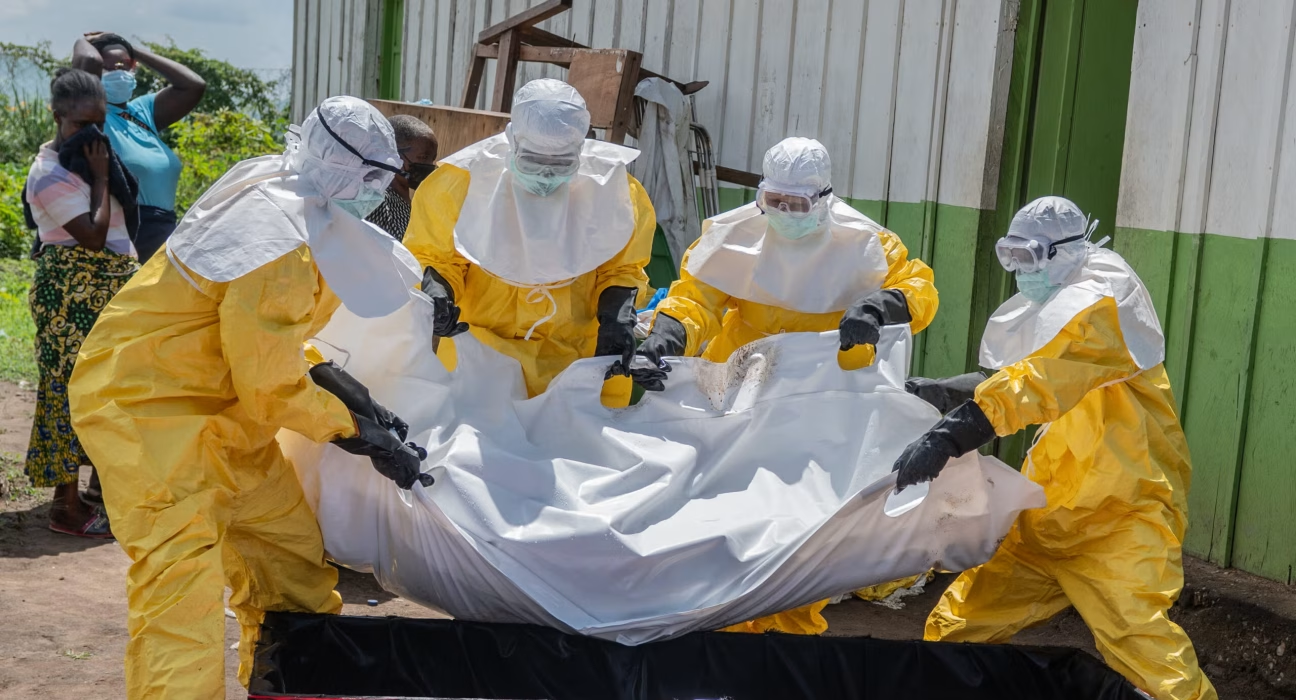
The Centers for Disease Control and Prevention (CDC) has raised concerns that the ongoing Ebola outbreak in Central Africa could escalate to levels similar to the devastating 2014–2016 West Africa epidemic if urgent public health measures are not intensified.

The warning follows newly released modelling data published in the agency’s Morbidity and Mortality Weekly Report on Friday. According to the CDC, the projections were developed to guide preparedness and response efforts amid growing uncertainty about the outbreak’s trajectory.
Speaking during a press briefing, Jason Asher, who leads the CDC’s Center for Forecasting and Outbreak Analytics, stated that the modelling shows “that scale is possible,” referring to the 2014 outbreak which recorded over 28,000 infections and more than 11,000 deaths.
However, he clarified that the projections are not predictions but tools designed to inform decision-making. “These are not forecasts,” Asher said. “They are planning tools meant to support action rather than create alarm.”
The CDC explained that its models assess four intervention scenarios, based on varying levels of patient identification, isolation, and treatment, ranging from low (20 percent) to very high (95 percent) effectiveness.
PAY ATTENTION: Follow The Lagos Voice on WhatsApp channel for latest updates
Under the weakest-response scenario, the agency estimates a 65 percent likelihood that infections could exceed 20,000 within three months if no additional measures are implemented.
Health officials say early indications prompt the warning that containment efforts on the ground may currently fall short. Satish Pillai, a CDC manager involved in the Ebola response, noted that the number of infected individuals requiring isolation remains uncertain, adding that existing response levels appear to be “on the lower end.”
The outbreak, declared on May 15 in northeastern Democratic Republic of Congo (DRC), involves the rare Bundibugyo strain of the Ebola virus. Experts believe transmission may have begun before the official declaration.
Latest figures from the World Health Organization (WHO) show 381 confirmed cases and 64 deaths in the DRC, with the epicentre in Ituri province. Cases have also crossed into Uganda, where infections and at least one death have been recorded.
In response to the growing threat, the WHO and the African Union’s public health body have jointly appealed for $518 million to fund emergency interventions over the next six months.
Public health authorities stress that a rapid scale-up in case detection, isolation, and treatment, similar to efforts deployed during the 2014 outbreak will be critical in preventing a wider regional crisis.