


“I am calling on the government and people of goodwill to intervene to get me out of my current situation. Kindly help me out of my predicament. I am begging you to treat me with compassion. I am calling on the government, particularly the president, to pity me and get me out of this serious situation.” – Leah Sharibu, 2018
The appeal above, calling for rescue and justice, was made eight years ago. Unsurprisingly, many Nigerians may no longer recognise Leah Sharibu’s emotional voice, as efforts towards her rescue have significantly diminished. Leah was just an innocent student until the school attack of February 19, 2018 at Dapchi, Yobe State, which changed everything.

Fourteen-year-old Leah, in a viral video in August 2018, had appealed to former President Muhammadu Buhari to rescue her and about 109 others abducted from Government Girls Science and Technical School in Yobe State. The young girl, who reportedly refused to renounce her Christian faith, has remained missing to this day. And the attack on schools, however, has never stopped.
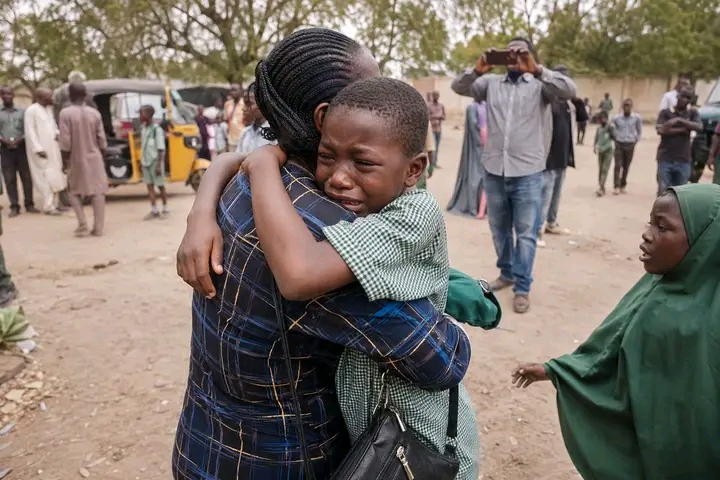
Emerging as one of the major news stories in the country, suspected gunmen descended and unleashed terror on Baptist Nursery and Primary School in Yawota and Community Grammar School Esiele, Oriire LGA, Oyo State on Friday, May 15, carrying out a coordinated mass kidnapping of pupils and staff. They threw the immediate victims, loved ones, family members, affected communities and the country at large into sorrow and uncertainty.
It is estimated that about 46 pupils and staff were abducted. Tragically, in a viral video a few days later, one of the abducted teachers, identified as Michael Oyedokun, was reportedly shot and beheaded. The state governor, Seyi Makinde, explained that increased pressure on terrorists and bandits in the North forced the attackers southward. What the governor failed to emphasise is that these assailants are not leaving the North to seek refuge in the South, but are instead bringing violence and tragedy to the region.
While most Nigerians are still mourning the Oriire tragedy, three Nigerians were killed and 15 others were abducted during a church service in Kwara State, on Saturday, May 24, 2026. On Monday, May 25, terrorists raided a police divisional headquarters, razed an emir’s palace and kidnapped 10 people in the Kiama council area of Kwara State. There is no doubt that the criminal abduction of Nigerians and the tragedy it continues to inflict on innocent citizens have not come to an end.
The attack by daredevil terrorists and kidnappers on Nigerians has indeed continued. The Oriire school abduction apparently clears doubt and reinforces concerns that schools remain targets, even under President Bola Tinubu’s Renewed Hope administration. The APC-led government has once again reinforced its reputation as an administration that has failed to deal decisively with the menace of insecurity and, as a result, stands indicted by its inability to contain it.
In fact, the government’s handling of insecurity and the country’s economic hardships have made kidnapping increasingly lucrative, while also making schools, churches, mosques and communities vulnerable targets. At this point, the argument that these attacks predate the current administration no longer holds weight against the expectations of citizens who place hope in the current administration.
If the government is willing to listen, Nigerians place far greater importance on justice for victims and their families than on the rehabilitation of individuals linked to terrorism. This concern became even more pronounced in mid-April 2026, when 744 terrorists and victims of violent extremism graduated from the Federal Government’s de-radicalisation, rehabilitation and reintegration programme under Operation Safe Corridor.
While efforts at de-radicalisation and reintegration may be presented as part of a broader security strategy, they cannot be more compelling or reassuring than the government’s duty to secure justice for victims, protect vulnerable communities and prevent further attacks. Any programme that appears to prioritise the reintegration of offenders without corresponding accountability risks deepening public distrust and undermining the fight against insecurity.
Nigerian schools have, in recent years, ceased to be safe spaces for teaching and learning, as they have increasingly become targets of criminal attacks and abductions. The fear that gripped Ogbomosho, Kwara, Ekiti, Ibadan and other parts of South-West Nigeria, following the abduction in Oriire Local Government Area, confirms the prevalence of insecurity into spaces once considered secure.
The tragic abduction further shatters the dangerous illusion that attacks on schools, pupils and staff are problems peculiar to Northern Nigeria. What is unfolding in South-West Nigeria is a national crisis that threatens the safety of students, undermines public confidence in education, and exposes the failure of authorities to adequately protect learning institutions across the country. It also reveals the weakness of the security architecture in the South-West and the nation at large.
Today, there is no longer doubt that no part of the country is immune from the sudden tragedy unleashed by gun-wielding assailants who show neither mercy nor regard for the law. From one region to another, Nigerians now live under the constant threat of violent attacks that can strike without warning. Travellers, students, traders now live in fear and suspicion of the dreaded daredevil terrorists, kidnappers, bandits and unknown gunmen.
It is unacceptable that the government still does not appear decisive enough, not only in pursuing these criminals, but also in effectively suppressing and preventing imminent attacks. Beyond official statements and assurances, Nigerians deserve counter strategies, swift accountability and concrete results. So far, justice has neither been seen to be done effectively nor delivered in a manner capable of reassuring citizens that the state remains firmly in control of the security situation.
PAY ATTENTION: Follow The Lagos Voice on WhatsApp channel for latest updates
Bad as the situation is, the handling of the latest crisis has been disgraceful. Efforts by political actors to quickly contain public outrage began almost immediately. President Tinubu issued a statement following the brutal killing of the mathematics teacher, describing the attack as ‘barbaric’ and assuring Nigerians that the kidnapped victims would be rescued. Two weeks after the victims are yet to be freed. For many citizens, such an assurance has done little to ease concerns, as they are seen as familiar rhetorics that are not always matched with swift, visible and decisive action.
As the state government, Governor Makinde initially promised daily press briefings, but these were discontinued after the second day, despite reports from security agencies announcing a series of intelligence-led arrests. While these efforts suggest that some action is underway, they have not been sustained in a way that keeps the public adequately informed or reassured. It is unbelievable that the concerned authorities have their full concentration towards rescuing the victims.
Attention has increasingly shifted away from the crisis, with political actors already engaging in manoeuvring ahead of the 2027 general elections. Party primaries and internal political contests in various quarters have now taken centre stage, further reinforcing public concern that governance priorities are being overshadowed by political calculations. In most media, President Tinubu’s latest 10.9 million APC primary votes have replaced the Oriire school abduction tragedy.
This recurring tragedy, which Nigerians have unfortunately witnessed far too often, already allows many to anticipate how this familiar story may unfold. So far, the abducted staff and pupils have not been rescued. Under the conditions surrounding such incidents, the fate of the children and staff, whose health and living conditions remain unknown, constitutes a serious indictment of political leadership at both state and federal levels, including the APC-led federal government and the Governor Makinde-led administration. The negative effects are incalculable.
Every abduction, especially those targeting schools, carries far-reaching consequences that extend beyond the immediate victims. While survivors often bear lasting physical and psychological trauma, alongside difficult challenges of reintegration after release, their families are left in prolonged anguish, living with uncertainty while struggling to seek answers and justice. At the community level, schools and learning activities are disrupted, thereby increasing the alarming out-of-school children statistics in the country.
For a government that purports to stand on the side of the people, there have been too many incidents to ignore, with the effects of these attacks being inestimable. In a turn-by-turn manner, Kankara in Katsina State, Kagara in Niger State and Jangebe in Zamfara State saw hundreds of students abducted within months. The attacks have expanded beyond what could be dismissed as isolated incidents.
In Kaduna State alone, the Nigerian Defence Academy, Afaka, and Bethel Baptist High School were both attacked within the same year, despite heightened military presence in the region. 2024 saw Kuriga, recording nearly hundreds of abducted pupils and staff, and by 2025, St. Mary’s Catholic School in Niger State suffered one of the largest single school kidnappings in Nigeria’s history, with more than 303 students and 12 teachers abducted in the raid. There are simply too many to count.
PAY ATTENTION: Follow The Lagos Voice on WhatsApp channel for latest updates
Since January 2023, no fewer than 816 pupils have been abducted in 22 separate attacks on schools across the country. The figures are as troubling as the uncomfortable truth that the incumbent president, who once spoke strongly against insecurity is now overseeing its persistence. President Tinubu, who was among the leading opposition voices in the aftermath of the Chibok attack, previously questioned the Jonathan administration’s capacity and fitness to govern. It has, as it has turned out, become a standard he is being currently judged against.
But that is not all. Mr Tinubu’s management of security initiatives, particularly regarding efforts to make schools safe, remains another point of public concern. As one of the countries implementing the Safe Schools Declaration, Nigerians and the world deserve to know how much has been invested and what the results of the figures are. Nigeria must strictly enforce its commitments and subject the implementation of its pledges to transparent accountability. Also, the Safe School initiative must be expanded beyond its original northeastern focus to cover all regions, as every part of the country now faces potential risk.
In addition, the pursuit of justice must involve actionable and credible deterrent measures. The current shortfall cannot continue to be a pattern. Kidnappers in Nigeria should not continue to operate for years with impunity, disappearing into forests with their victims, collecting ransoms and returning for further attacks. There is no better time to benefit from the intelligence units in the country than now. It is high time security operatives are used to tackle security threats, rather than for political machinations.
It is equally important for all stakeholders, including state governors across South-West Nigeria, to intensify efforts and take bold steps to secure the release of all abducted pupils and staff. As leaders, political officeholders must work in synergy to confront the growing security threats spreading across the region. A tactical security summit, beyond formalities, needs to be convened to discuss and map defensive and counter-strategies. To spill the bitterest part of this truth, whether school abductions would continue or be reduced will depend significantly on how effective and coordinated the response of Nigerian political leaders and stakeholders is. The time to protect our schools is now.
Ejuchegahi Angwaomaodoko, the founder of Ejuchegahi Angwa Foundation, and a scholar at Kean University, writes via ejuchegahi.angwaomaodoko@gmail.com